90s East Coast Rappers Legendary Figures

- 1.
“Yo, Who Was Really Rockin’ the Mic Back in the 90s?”
- 2.
From Concrete Jungles to Global Stages: The Rise of East Coast Lyricism
- 3.
Beat Science and Jazz Samples: The Sonic Blueprint of the 90s
- 4.
Crews, Collectives, and the Brotherhood of Bars
- 5.
Legacy in Lo-Fi: How the 90s East Coast Sound Lives On
- 6.
Lyricism vs. Lifestyle: The Duality of 90s East Coast Icons
- 7.
Queensbridge, Brooklyn, Harlem: The Neighborhoods That Raised Legends
- 8.
The Golden Era’s Greatest Hits: Albums That Changed the Game
- 9.
Rivalries, Respect, and the Unspoken Codes of the Cipher
- 10.
Where Are They Now? The Enduring Glow of 90s East Coast Royalty
Table of Contents
90s east coast rappers
“Yo, Who Was Really Rockin’ the Mic Back in the 90s?”
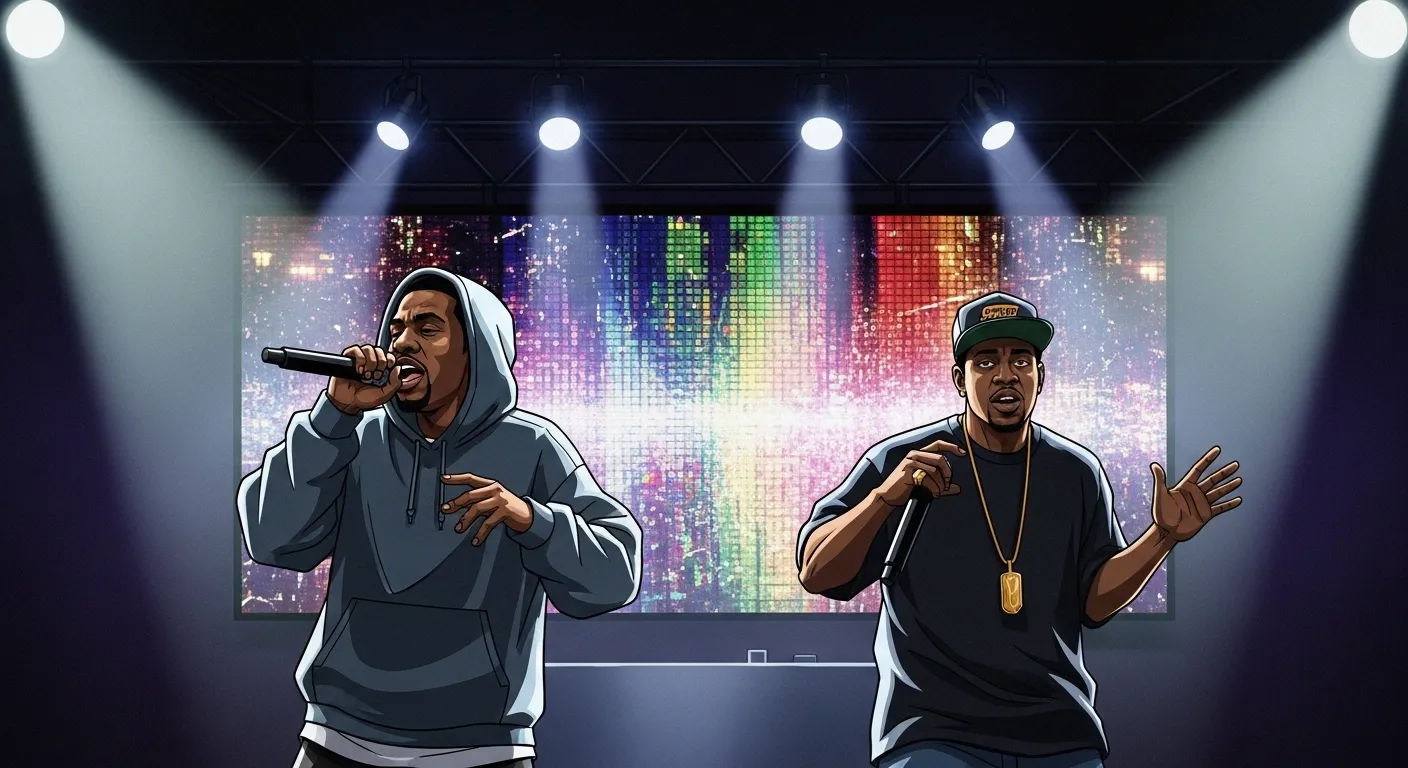
Ever wonder how a buncha knuckleheads from Queensbridge, Bed-Stuy, and Harlem turned four bars into gospel and a dusty drum break into the national hymn of the concrete jungle? Straight up—the 90s east coast rappers didn’t just spit rhymes; they rewrote the whole damn dictionary with a Bic and a backpack. While Cali was rollin’ low with Parliament beats and Atlanta was still boilin’ syrup in grandma’s kitchen, the East was servin’ raw truth over snare hits so crisp they crackled like fall leaves in the Bronx. Nas creepin’ through your headphones like that one cousin who knew all the block rumors? Biggie droppin’ wisdom with a grin like he just won the Lotto on a Tuesday? That’s the magic. The 90s east coast rappers weren't just emcees—they were street poets, block historians, and lyrical hustlers who turned pain into punchlines and subway graffiti into fine art.
From Concrete Jungles to Global Stages: The Rise of East Coast Lyricism
When hip-hop hit its awkward teen phase in the '90s, the 90s east coast rappers grew up faster than a bodega cat learnin’ to dodge rats. They swapped cheesy party chants for layered metaphors that hit harder than a Philly cheese steak sandwich to the chest—and flows smoother than your grandma’s sweet tea on a July porch. This wasn’t just flexin’—it was survival through syllables. Rakim laid the foundation like a Harlem bricklayer, but then came Black Thought spittin’ PhD-level verses, AZ with his velvet-voiced calculus, and Big L droppin’ bars so cold they shoulda come with a parka. Every track? A chapter in the Great American Street Novel. And the 90s east coast rappers? They were the pen, the paper, and the whole damn publisher.
Beat Science and Jazz Samples: The Sonic Blueprint of the 90s
Aight, real talk—you can’t even whisper “90s east coast rappers” without bowin’ to the beat gods behind the boards. DJ Premier, Pete Rock, Large Professor—they weren’t just cookin’ beats; they were mixologists of mood, diggin’ through crates of dusty vinyl like archaeologists huntin’ jazz gold. That mournful sax loop from a '60s Coltrane cut? Perfect for Nas paintin’ the Projects like a Van Gogh with trauma. That mellow piano ticklin’ through 2 a.m.? That’s Biggie’s soundtrack for countin’ paper under flickerin’ streetlights. The sonic soul of the 90s east coast rappers wasn’t just music—it was memory soaked in reverb, prophecy wrapped in drum breaks, and legacy pressed onto wax.
Crews, Collectives, and the Brotherhood of Bars
Back then, you didn’t just rock solo—you repped your squad like it was your bloodline. Wu-Tang Clan? Nah, that was a Shaolin monastery with mics instead of swords. Native Tongues? Peace, intellect, and funk so deep it made your sneakers bounce. And don’t sleep on D.I.T.C.—Diggin’ in the Crates was like the Avengers of lyricism, but with more Timberlands and less CGI. These weren’t just rap groups; they were brotherhoods bonded by cipher oaths and shared subway tokens. The 90s east coast rappers knew real G’s multiply strength, not subtract it. When a posse cut dropped, it wasn’t a track—it was a neighborhood proclamation blasted from boomboxes on every stoop from Staten Island to Spanish Harlem.
Legacy in Lo-Fi: How the 90s East Coast Sound Lives On
Even now, whether you’re scrollin’ TikTok or catchin’ a cypher in a Brooklyn basement, you hear the ghost of the 90s east coast rappers in every flipped jazz loop, every internal rhyme that snaps like a fresh pack of gum. Artists like Joey Bada$ ain’t copyin’—they’re channelin’, like spiritual descendants with Air Force 1s and analog synths. That “lyrics over looks” code? That mic-check-before-you-step respect? That’s straight-up 90s East Coast DNA. Without it, half the so-called “conscious rap” today would sound like a dentist’s office playlist with curse words—smooth, but empty.

Lyricism vs. Lifestyle: The Duality of 90s East Coast Icons
Here’s the real on-the-street scoop: the 90s east coast rappers lived in the gray zone—where street tales met Shakespearean flow. Biggie could break down a corner hustle like he was teachin’ MBA class, then pivot to a metaphor about life bein’ chess on cracked concrete. Nas didn’t just describe Queensbridge—he made it breathe, bleed, and dream in HD. This wasn’t contradiction; it was depth. These cats proved you could sling slang and still quote Sun Tzu, that your block could be both battleground and library. That’s why the 90s east coast rappers still hit different—they weren’t just tough; they were thinkers with Timberlands.
Queensbridge, Brooklyn, Harlem: The Neighborhoods That Raised Legends
You can’t pull the 90s east coast rappers from their roots any more than you can take the cheese outta a Philly hoagie. Queensbridge Projects? That’s where Nas sculpted Illmatic like Michelangelo in a hoodie. Bed-Stuy corners? Biggie’s throne room, where every rhyme dripped with Crown Heights flavor. Harlem bred lyrical lions like Mobb Deep and Cam’ron, spittin’ fire between soul food spots and brownstone stoops. These weren’t just neighborhoods—they were pressure cookers of genius. Every spray-painted wall, every late-night dice game, every bodega coffee cup passed hand-to-hand fed the verses that would echo for decades. The 90s east coast rappers showed the world that brilliance grows wild—even where the pavement’s cracked and the streetlights flicker like old jazz records.
The Golden Era’s Greatest Hits: Albums That Changed the Game
Let’s geek out for a hot sec—here’s a no-skip list of albums from the 90s east coast rappers that still knock harder than your pops yellin’ “Lights out!” at midnight:
- Illmatic – Nas (1994)
- Ready to Die – The Notorious B.I.G. (1994)
- Enter the Wu-Tang (36 Chambers) – Wu-Tang Clan (1993)
- The Chronic? Hold up—that’s Cali. Stay focused, fam.
- It Was Written – Nas (1996)
- Life After Death – The Notorious B.I.G. (1997)
These weren’t just albums—they were sonic time capsules, street testaments, and cultural Molotovs wrapped in shrink-wrap. Every play feels like sneakin’ into your older brother’s journal and findin’ poetry where you expected scribbles. That’s the spell of the 90s east coast rappers.
Rivalries, Respect, and the Unspoken Codes of the Cipher
Yeah, sure—the whole East vs. West drama got loud. But don’t let the headlines drown out the real heartbeat of the 90s east coast rappers: respect. Even when bars cut deep, it was about skill, not shade. Ghostface once said he’d rather fold in a battle than disrespect a real one—and that wasn’t flex, that was faith. The code was simple: honor the craft, honor your peers, and never fake the funk. Beef? It happened. But the cipher? That was sacred ground. And in that circle of freestyles and feedback, the 90s east coast rappers built a legacy thicker than November fog on the Brooklyn Bridge.
Where Are They Now? The Enduring Glow of 90s East Coast Royalty
Some of the 90s east coast rappers are still in the booth—Nas droppin’ albums like vintage Bordeaux, Raekwon stackin’ Wu legacy like bricks in a Fort Greene brownstone. Others, like Biggie and Big L, left too soon but echo like subway trains through tunnels of memory. Their spirit? You hear it in every freestyle on a Bronx fire escape, every college kid quoting “Memory Lane” like it’s scripture. And if you’re lookin’ to go deeper, start at the Raashan Net homepage, dive into the Rap section, or geek out on beats with Best Beats for Rappers Top Picks. The flame ain’t gone—it’s just burnin’ low, waitin’ for ears ready to truly listen.
Frequently Asked Questions
Who were the East Coast rappers in the 90s?
The 90s east coast rappers included household names like Nas, The Notorious B.I.G., Wu-Tang Clan, Jay-Z, Big L, Mobb Deep, Rakim, and Black Thought. These artists defined a golden era of hip-hop with intricate lyricism, jazz-influenced beats, and streetwise storytelling that shaped the genre’s future.
Who was a popular rapper in the 90s?
Among the most popular rappers of the 90s—especially from the East Coast—were The Notorious B.I.G. and Nas. Their debut albums, Ready to Die and Illmatic, are widely regarded as masterpieces. The 90s east coast rappers dominated charts and cipher sessions alike, blending commercial success with critical acclaim.
Who was the old East Coast rap group?
One of the most iconic old-school East Coast rap groups was the Wu-Tang Clan, formed in Staten Island in the early 90s. Other legendary crews include Native Tongues (A Tribe Called Quest, De La Soul) and D.I.T.C. (Diggin’ in the Crates). These collectives pushed the boundaries of what 90s east coast rappers could achieve together.
Who were the hip-hop artists in the 80s and 90s?
While the 80s gave us pioneers like Run-D.M.C., LL Cool J, and Eric B. & Rakim, the 90s exploded with lyrical giants such as Nas, Biggie, Jay-Z, and Wu-Tang Clan. Together, these artists—including the definitive 90s east coast rappers—transformed hip-hop from party music into a global art form rooted in narrative, rhythm, and resistance.
References
- https://www.rockhall.com/inductees/wu-tang-clan
- https://www.npr.org/2014/04/18/304464948/nas-reflects-on-20-years-of-illmatic
- https://www.britannica.com/art/hip-hop
- https://daily.yale.edu/remembering-big-l